 We spent a couple of weeks in the Flamingo area of the Everglades, and decide to make it our basecamp for a journey that Kim and I have wanted to do since our paddle in the upper part of the Wilderness Waterway five years ago. The trip will take us from the southern end of the state at Florida Bay at Flamingo up the one hundred plus mile journey to the Everglades City Ranger Station, and will take us six days and five nights.
The winds are screaming out of the south the morning of our departure, so after looking at our maps, we decide to launch at Hell's Bay (about 8 miles east of the Waterway) in order to avoid the rough waters of Whitewater Bay. Dave graciously volunteered to be our shuttle, so off we went from Flamingo Campground, to the small roadside launch.

Day 1:
Our route for today will take us through Hell's Bay, a twisting winding labyrinth of tightly intertwined mangroves, marked only by a series of white PVC pipes (thank you Park Rangers!).

Once through "Hell" we will break out into a serties of small bays and lakes that eventually allow us to work our way to northward roughly 10 miles to North River Chickee for our first night's stay in this remote wilderness.
I guess the name Hell's Bay is misleading, more like Hell's tunnels. Negotiating this ticket of tangled, low-hanging stuff took about 3 miles of careful paddling before we could ever crank the motor.


 You might say, why the motor??? Being "purist" padders, we learned while in Alaska that there are many places we missed a great experience because of the distances involved.
So, we decided to try this combination of a larger tandem canoe and the little 26lb Honda 2hp, 4-stroke engine. It turns out it made this 100+ mile trip enjoyable, allowing us plenty of time to explore and to arrive early each day at our next camp and just relax.
We spot Rodgers River Chickee (a double) which is guarded by a large Osprey nest.
It's been almost 4 years since we did our first Everglades paddle. We learned that mosquitoes don't bother you on these elevated platforms, set a distance from the thicker shoreline.
It's been almost 4 years since we did our first Everglades paddle. We learned that mosquitoes don't bother you on these elevated platforms, set a distance from the thicker shoreline.


 Soon we arrive at North River. As I look down into the canoe from the platform, I wonder how we managed to get all that gear in there without sinking! (Sorry for the pix, it's 2 shots stitched together, our canoe really isn't bent quite that bad.)
 Kim relaxes for our first evening on the water as I take a look at the map for tomorrow...
Day 2:
Our second day we start to run more westward, towards the Wilderness Waterway, intercepting it at Oyster Bay, then run northwest to Harney River, where we will enjoy night two in the mangroves of southern Florida.

As I just sit back and relax while our little Honda does all the work, I know we've made this right decision for this long haul. Hey - we can pick up those paddles any time we want, right?
We enjoy just puttsing along and are a bit taken to discover, of all things, a lone Cattle Egret way out here in the mangroves!


A couple more hours and we are camped once again at another beautiful area, with plenty of time to start cooking. One of the nice benefits of staying on the chickees out here is the park provided porta-cans. Interesting how even a few of the comforts of home can be so appreciated out in the boonies!


Day 3:
Ok so today should be a bit interesting. The winds are up, and we elect to try "The Nightmare". This is another extremely tight trek through entangled mangroves that can only be accomplished at near high tide. The jouney would take us through the lower portion of the "mare" then we'd divert to the gulf, due to low water (low tide), and through the beautiful Rogers River, eventually to a nice chickee at Rogers River Bay.

 The Nightmare is no exaggeration. Not only do we have to kill the engine, but literally have to pull our way through the tangled bushes in tight areas. This can only be appreciated by watching our video of the trip. http://www.youtube.com/watch?v=UYy8LeZn1Ec
 About halfway through the "mare", we opt to head west to the gulf. Yes, the Gulf of Mexico. We enter this huge mass of water in our little canoe to find it dead calm, what a relief!
With the help of the Honda, it takes us a fair amount of time to locate the mouth of the Rogers River, as it is a wide bay-like entry, dotted with many, many, small islands. Round and round we go, until finally we are in what appears to be the river and start to enjoy it's abundant wildlife (again see the video also).
The upper end of the River is glass smooth, we back the engine down to a mere idle, and enjoy the birds as we creep along the channel.
The upper end of the River is glass smooth, we back the engine down to a mere idle, and enjoy the birds as we creep along the channel.


Rogers Bay is also like a sheet of mirror, and is absolutely beautiful! We're glad to arrive early, set up camp and really enjoy this island of solitude amidst such a pristene environment.

I opt for a paddle around the chickee, while Kim just relaxes, taking a few pictures and enjoy.


We just sit back and enjoy a nice evening, watching the sun set behind a layer of thin clouds.

 The moon appears as the clouds melt away, treating us to it's soft light for the evening.
 We awaken to a beautiful sunrise, making this spot the most enjoyable of the entire journey.
We linger this morning, taking all this beauty and quiet in, before we launch for another day's adventure.


Day 4:
Today's trip takes us through mostly open bays and up to Plate Creek chickee, which is nestled against a small mangrove island in the middle of a large lake.
Today's trip takes us through mostly open bays and up to Plate Creek chickee, which is nestled against a small mangrove island in the middle of a large lake.

We arrive early enough to rinse out our clothes, do a bit of housekeeping, and enjoy playing with the numerous inhabitants of the campsite.


 As I sit back and enjoy the cool eve, we're treated to another nice sunset.
Day 5:
It's our longest run today, about 15 miles, so we once again are very happy to have the little engine which makes the span a pleasure. It allows for a stop at Darwin's Place as we motor northward to what will be our final night at Sunday Bay.

 Darwin's is an old homestead, made interesting by scattered remnents of the past. The video will give you a better idea of the homesite.
 The most interesting artifact is this old conch shell, most likely remains of the past indian inhabitants of the many islands of the 'Glades. http://www.nps.gov/history/history/online_books/natural/7/nh7e.htm
 Having come roughly a hundred miles from Flamingo, we arrive at Sunday Bay (actually the sign was from way back...we never figured out their numbering system, but it certainly wasn't miles!)
We enjoy our last afternoon on the chickee, this one being the only one with a built in bench!
Day 6:
Our last day takes us northwest once again, through the Turner River system and back into civilization at Chokoloskee Island. The island is a thriving fishing community linked to Everglades City by a long causeway.
 Dave has arrived to provide the shuttle back to Flamingo, but we opt to explore Chokoloskee before heading "home". We enjoy a visit to Smallwood's Store, a well-preserved reminder of days gone by here in the 'Glades, when it was once truly one of the most remote parts of the U.S.


What a journey we had. We'd planned to come back and do the Waterway for years, and now we can enjoy this trips for years in the future as we look back on another great adventure.
If you haven't watched the accompanying video of the trip be sure to take a look at http://www.youtube.com/watch?v=UYy8LeZn1Ec http://www.youtube.com/watch?v=UYy8LeZn1Ec
Day 6:
Our last day takes us northwest once again, through the Turner River system and back into civilization at Chokoloskee Island. The island is a thriving fishing community linked to Everglades City by a long causeway.
 Dave has arrived to provide the shuttle back to Flamingo, but we opt to explore Chokoloskee before heading "home". We enjoy a visit to Smallwood's Store, a well-preserved reminder of days gone by here in the 'Glades, when it was once truly one of the most remote parts of the U.S.

What a journey we had. We'd planned to come back and do the Waterway for years, and now we can enjoy this trips for years in the future as we look back on another great adventure.
If you haven't watched the accompanying video of the trip be sure to take a look at http://www.youtube.com/watch?v=UYy8LeZn1Ec http://www.youtube.com/watch?v=UYy8LeZn1Ec
 On our whole 100 mile journey on the Wilderness Waterway, we saw very few birds. Many of the birds were killed off at the turn of the century by plume hunters. Because of the fashion rage at the time of adorning beautiful bird feathers on articles of clothing, high prices were paid for the feathers on many of the birds that lived in the glades. Rookeries so thick there were nest on nearly ever branch filled the swamps. Plume hunters would hunt the birds during breeding season when fledglings filled the nests. This is a time when the bird's feathers are the most beautiful. They would shoot all the adult birds, pluck them of their wanted feathers and leave their carcasses there to rot. The fledglings in the nests would be left at the mercy of the hawks and vultures that patrolled the area. Thankfully, this practice was put to an end, but not before much damage was done.
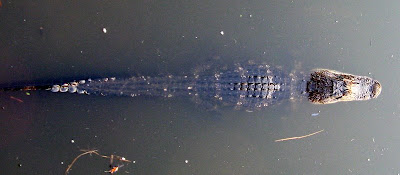 Of course, the same thing was done with the alligator. The story with the alligator is different. For whatever reason, the American Alligator has made a much bigger comeback than the birds have. Habitat destruction through drainage of the glades and pollution are probable causes of this.


 The Anhinga, or "snake bird" as called by some, can ben seen nearly everywhere there is fresh water. You will either see it swimming with it's head and neck sticking out of the water catching fish or drying it's wings on a sunfilled branch.


 Perhaps the bird we saw the most often, was the osprey. In some places, such as Flamingo, there were dozens flying around in view of each other. Nests were sometimes only hundreds of feet away from each other. This bird has definitely made a comeback!


