April 8, 2009

Everglades Wildlife

I'll bet most people expect to see a lot of wildlife when they come to the Everglades. I know we did. We've all probably seen the same Disney or wildlife documentaries showing all the beautiful wading birds and alligators that are supposed to live there. Well, they still do but in much smaller quantities than I knew. From what I've learned since we arrived, over 90 percent of the beautiful birds that inhabited the area since the 1930's have disappeared. Would I have ever loved to have seen this area over a 100 years ago!

On our whole 100 mile journey on the Wilderness Waterway, we saw very few birds. Many of the birds were killed off at the turn of the century by plume hunters. Because of the fashion rage at the time of adorning beautiful bird feathers on articles of clothing, high prices were paid for the feathers on many of the birds that lived in the glades. Rookeries so thick there were nest on nearly ever branch filled the swamps. Plume hunters would hunt the birds during breeding season when fledglings filled the nests. This is a time when the bird's feathers are the most beautiful. They would shoot all the adult birds, pluck them of their wanted feathers and leave their carcasses there to rot. The fledglings in the nests would be left at the mercy of the hawks and vultures that patrolled the area. Thankfully, this practice was put to an end, but not before much damage was done.
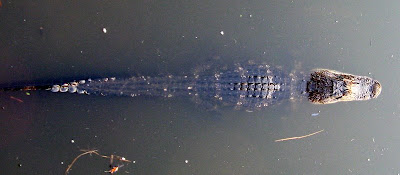
Of course, the same thing was done with the alligator. The story with the alligator is different. For whatever reason, the American Alligator has made a much bigger comeback than the birds have. Habitat destruction through drainage of the glades and pollution are probable causes of this.


That doesn't mean you won't see anything when you visit the area. We did find pockets of wildlife in different areas. A couple of the best are the Royal Palm area and the Loop Road of the Tamiami Trail. Probably the bieggest concentration of alligators I had ever seen were on the Anhinga Trail. They were in every nook and cranny along the trail.


Since it is breeding season, I was lucky enough one morning to watch and hear the males bellowing to the females. Watching them arch their back and stick their heads out of the water and roar was an experience I'll never forget. The water would vibrate above their bodies. Often, I would find 2 gators next to each other bellowing to some female I couldn't see.


The Anhinga, or "snake bird" as called by some, can ben seen nearly everywhere there is fresh water. You will either see it swimming with it's head and neck sticking out of the water catching fish or drying it's wings on a sunfilled branch.


The Anhingas had fledglings in their nests with snowy white babies squawking for food.


The Great Blue Heron is a large predatory bird that will eat just about anything. I found myself amused with their antics.


A few other common birds found in these southern wetlands are the night herons and the green herons.


I spied a flock of blue winged teal that were late in migrating north for some reason.

We caught several sightings of the Swallow-tailed Kite. It is a beauty to watch as it sails through the skies on it's search for insects.

Perhaps the bird we saw the most often, was the osprey. In some places, such as Flamingo, there were dozens flying around in view of each other. Nests were sometimes only hundreds of feet away from each other. This bird has definitely made a comeback!


April 4, 2009

Key West!

Having lined up the ferry ride to Dry Tortugas, we opted to leave a day early and do Key West...wow! What a fun place! Dave offered to do the driving, the only challenge was to get three people's clothes, food & camping gear into the back of the Jeep Rengade! But Kim said she'd ride in the back, even if it was tight, and boy it was....I couldn't get a pix of the rear compartment, because things were crammed in every corner and stacked to the ceiling. Oh well, we're off to have a weekend of fun!

I guess we had all forgotten how beautiful a drive it was. With a TGIF attitude and nothing but white beaches and blue-green water, we were off & runnin'.
First stop in Key West was Mel Fisher's Treasure Museum and shop. Nathan's (my oldest Son) grandfather, Lou Tilley, was a key stockholder in Treasure Salvors when the Atocha and it's $400Million in treasure was found. Thanks to Lou supplying the two large tugboats that help make the discovery possible. BUT, that's another whole story, so check out http://www.melfisher.com/ and if you really want the whole story, get a copy of Eugene Lyon's book on the Atocha, it's great!


Having done the Atocha thing, we moved on to the Key West museum, where we actually became part of the exhibits! Even Dave decided to get into the act, and boy, do he ever!

Kim & I discovered the art of Mario Sanchez and immediately fell in love with it's simplicity, and 3-dimesional details, Dave disappeared, I think to have a date with Marilyn downstairs!

Back outside, we perused the shell and sponge shops, walked along the beautiful harbor, and tried to make ourselves into art once again.
Kim's stamina for window shopping was unending, Dave & I opted for a cold one and some shade on a nearby harborview bench. We were all waiting for the Sunset Festival - Key West's nightly street performers fair.
As the sun became a dull red, and the crowds grew, we were caught by the very first act...what a show, juggling sharp objects, even directly over folks heads, and lying on a bed of nails with someone walking on top of you for the finale!


But Kim's favorite was "CatMan", yes a really crazy, goofy Frenchman who trains cats to do acts similar to tigers & lions at a circus....the pix tell the story!
I guess I must admit, my personal favorite was the one-man band...what an act...check out the video at http://www.youtube.com/watch?v=wAKuXEvMnH8

March 26, 2009

Ortona Locks & on to Flamingo


In our travels, we are always looking for unique places to camp for a few days at a bargain price. We've learned through experience that the Corps of Engineers CGs are often some of the nicest, and always economical for what they offer. Ortona Locks is one of those interesting jewels of the Corps.

Located along the Okeechobee Waterway, stretching out from both directions, the waterway extends westward to the Gulf of Mexico using the Caloosahatchee River and eastward to the Atlantic Ocean, a tremendous timesaver for boaters crossing the State!


As we pull in, we are greeted by a pristinely clean grounds and stunningly tall palms.


Later in the day, Dave and Sam have fun watching a couple of sailboats cycle through the locks, pretty interesting process which takes about 30 minutes.


Once the boats are in and tied up to the walls, we enjoy a "waterfall" to our right as the "uphill" lock doors are opened.


Meanwhile I found numerous Eastern Meadowlarks on the site that appear to be tame, and pose for this nice pix.


The following day, we take this opportunity to try the 2hp Honda outboard on a long straight run up & down the waterway to determine fuel milage before attempting the Everglades Waterway.


Sam is really pleased to calculate roughly 40mpg! Quite efficient for moving our big canoe along at almost 6mph.


After a nice stay, we move southward. If you're in this area, be sure to try the Ortona.


After leaving Ortona Locks, we head to Flamingo. Just the name itself brings to mind a couple of different things. Either you're thinking of that gorgeous, leggy, pink bird that is seen mostly in zoos or you're thinking of those plastic ornaments that are sometimes seen on front lawns. You'd be surprised to find out that the real Flamingo is nowhere near that tacky 0r a place that you'd likely see the real thing.


We never saw a single Flamingo while we were in Flamingo. The most common bird we saw was the Black Vulture.


I learned a few things about vultures. One thing is that this species is very intelligent. We watched a few of these clever feathered creatures try to remove a bag of bread that our neighbors left in the barbecue pit. Evidently it was left there so that it wouldn't be shredded to pieces.


The next thing I learned was that vultures don't eat just dead bodies of creatures. These guys looked like they were trying to figure out how to get the charcoal out of the bag.


A face only a mother could love...


We did see a few other birds while we camped in this area. Migrating shorebirds lined the beaches and the mangrove ponds. Osprey were everywhere by the handfuls.


The oak trees and the moss survive after several hurricanes even though several of the buildings in the area had not.


Although there were not large amounts of flowers blooming, we did find patches of color in a few places.

It never failed - every evening was a spectacular sunset.